

An A-Z of Architectural Terminology
At LA London, we aim to work with clients in a way that is as clear, straightforward and transparent as possible. Any architectural project, however, inevitably involves a degree of technical jargon: words, phrases and acronyms that may be familiar to us as architects, and to the wider construction industry, but that are less so to our clients.
To help demystify and clarify the complex architectural process, we’ve put together a list of some of the most commonly used words and phrases that we encounter regularly in our day-to-day lives, with a brief explanation of what they mean.
Air Tightness Test
Mandatory for new builds in the UK, an air tightness test measures how much air is escaping from cracks and gaps in the building. Poor air tightness undermines insulation performance and the efficiency of MVHR (Mechanical Ventilation Heat Recovery) systems.
Axonometric (Axo) drawings
An axonometric drawing is an orthographic 3D view that is proportionally and dimensionally accurate. In a 3D space, it can be rotated around one or more of its axes to show the different sides of a building. It’s a useful tool to help clients and contractors to better visualise 2D drawings in 3 dimensions.
BIM

Working on a BIM model
Building Information Modelling (BIM) is a way of creating a detailed digital model of a building so everyone involved—architects, engineers, builders, and clients—can see the same information, spot problems early, and plan the construction more accurately. It’s essentially a smart 3D model that contains not just the geometric shape of the building, but also data about how it works and how it will be built.
Blue roofs
Blue roofs, as opposed to green roofs, temporarily store water from storms or heavy rainfall and then release it gradually. They are typically constructed on flat roofs in urban areas at risk of flooding.
Building Safety Act (BSA)
Introduced in 2022 following the Grenfell Tower tragedy, the Building Safety Act is a UK law created to improve public safety through stricter enforcement of building regulations for Higher-Risk Buildings (HRBs). HRBs are any building of 7 storeys or more, or at least 18m high, and containing two or more residential units. The act established a new Building Safety Regulator and introduced new statutory roles, documentation and procedures, notably the Golden Thread. We discuss it in more detail here.
Building Safety Regulator
A body established by the BSA (see above), the Building Safety Regulator is part of Health and Safety England. It acts as the regulator for higher-risk buildings and applications for HRBs must be submitted to it rather than local authority or independent Registered Building Control Approvers.
Certificate of Lawfulness
A Certificate of Lawfulness, or Lawful Development Certificate (LDC) is a formal document from a local authority confirming that work is lawful under permitted development (PD). Without it, even compliant work can be challenged when selling or refinancing.
CIL (Community Infrastructure Levy)
Local authorities in the UK can impose a levy on new developments of more than 100m², which is put towards local infrastructure such as transport, schools and public areas. Strategic planning and phasing can help clients reduce or avoid this levy.
Circular Economy
Adopting the principles of the circular economy in building design means prioritising retention and refurbishment over demolition and rebuilding. Buildings can be adapted, reconstructed and deconstructed to extend their life and components and materials can be salvaged for reuse or recycling.
Client Contingency
Contingencies are risk estimates, typically 5-20% of a budget, set aside for unexpected site issues, design changes, price increases, or weather delays. They allow construction teams to adapt to these risks, preventing cost overruns and delays.
Cold Bridge/ Thermal Break
Cold bridges are weak points in a building’s insulated fabric that allow heat to pass through more easily, which can cause heat loss, condensation or mould. They occur where materials that are better conductors of heat form a ‘bridge’ between the inner and outer faces of a construction. This often happens where there is a gap in the insulation or where an element like a joist penetrates the insulation layer of a construction. Correct detailing utilising Thermal Breaks prevents cold bridges by introducing an insulative material that stops heat from easily passing through part of a building, preventing heat loss, reducing cold spots, and stop condensation forming and protecting finishes such as joinery and plaster.
Commuted Financial Contribution
Local planning policy stipulates that developments over a certain size (usually between six and ten units) must include affordable housing. A Commuted Financial Contribution is a payment developers make to local councils instead of building affordable homes on-site. When adding units or changing use, private schemes may owe a Commuted Financial Contribution, even without on-site affordable housing.
Conservation Area
An area of special architectural or historic interest, which is considered worthy of preservation or enhancement. Planning rules are typically stricter for new development, but high-quality contemporary design is often permitted if it respects the character of the area.

A significant proportion of LA London’s projects are in the conservation areas of prime central London
Cost Plan/ Pre-tender Estimate
A cost plan or pre-tender estimate (PTE) is the final estimate of the likely cost of the works described in completed tender documents. Prepared by a Quantity Surveyor/Cost Consultant, it covers all construction costs plus provisional sums for any undefined elements, contingencies, preliminaries and inflation. The PTE enables the client to confirm that sufficient funds are available before seeking tenders. It also gives a basis for assessing and comparing tenders when they are returned.
D&B (Design and Build) Contract
A D&B contract is one where the client passes on responsibility for both designing and building the project to a contractor. Fewer contractual relationships reduces risk for the client and can make the process quicker and more efficient. However, quality can suffer as the contractor has more freedom to select their own products and materials.
Daylight/Sunlight Assessment
A daylight assessment is a technical report that outlines the impact of a development on the natural light received by neighbouring properties. Often required for extensions, it details both existing and expected levels of daylight, sunlight and overshadowing, as well as the measures that will be taken to reduce the expected impact of the proposed development.
Defects Liability/ Rectification Period
This is a period specified in construction contracts, typically lasting 6 to 12 months after completion, when a contractor is liable for any latent defects and must correct them. The employer will have withheld a sum of money (“retention”), which gets released to the contractor at the end of the rectification period, or used to pay another contractor to make good any defects if the original contractor won’t.
Design Development
Design development is the phase following concept design, where the design of a building is refined and technically coordinated. Finishes, materials and services integration are all specified at this stage, preventing costly redesign.
Design Intent
Design intent is the underlying purpose, goals, and logic guiding a design, defining why and how it should look and work. It guides decisions about functionality and aesthetics. Protecting intent ensures later technical decisions don’t erode quality.
Detail Drawings

Detail drawings are typically large-scale, highly precise technical drawings showing precisely how a particular element of a project is to be constructed These might include structural elements or construction junctions like glazing edges, waterproofing and insulation. Detail drawings can help to reduce the risk of defects and disputes.
Dew Point
Dew point is the temperature at which moisture forms inside construction layers. A higher dew point means the air is more humid, which can cause invisible decay, mould and structural failure. It is vital that the dew point occurs externally of the vapour barrier in a construction build-up in order to avoid internal condensation.
Embodied Carbon
Embodied carbon is a measure of the carbon emissions created by a building or infrastructure throughout its whole lifecycle. It includes processes and materials used to build, run, repair, and refurbish a building.
Feasibility Study
An early-stage assessment used to determine the viability of a particular construction project. It analyses site location and design options to determine planning risk, cost implications, and structural constraints.
FF&E (Furniture, fixtures and equipment)
This refers to all loose items in a building. Fixtures include lighting, mirrors and shelving, while equipment includes kitchen appliances, computers and specialist equipment. FF&E needs to be coordinated with M&E (mechanical and electrical) services, lighting and general spatial planning.

A recent LA London project on a private estate in Surrey
Fire Rating
A tested performance rating that determines how long a building element can resist fire exposure. It is expressed in terms of time, e.g. 30 minutes.
Fire Strategy
Required to support planning and building regulations compliance, a fire strategy is a document that outlines the necessary fire safety measures for a building, including compartmentation, escape, smoke control and structural fire performance.
Gateways & HRB
The BSA established three gateways in design and construction for HRBs, introducing new requirements during construction. These were created to strengthen regulatory oversight of high-risk building design and construction:
● Planning Gateway one – at the planning application stage
● Gateway two – before building work starts
● Gateway three – when building work is completed
These gateways require evidence of safety compliance at planning, design and delivery stages, which can affect the overall cost and timeline of a project.
GA Drawings
General arrangement (GA) drawings are legally scaled drawings showing the position, orientation and spatial relationships of a structure. They form the basis of planning, coordination and contract documents and are usually supported by detailed plans, elevations and sections.
Golden Thread
The Golden Thread is the requirement under the Building Safety Act for certain buildings to have a single, reliable, continuously-updated record of all information needed to understand, manage, and keep the building and its occupants safe throughout its life.
In simple terms: it is a live, digital record that shows what was built, how it was built, and how it should be safely managed, ensuring that accurate and current information is always available to those responsible for the building’s safety.
Green roofs
A green or living roof is one that is covered with vegetation such as grass or sedum. The environmental benefits include heat reduction and energy conservation. Green roofs can also attract beneficial birds and insects such as bees and butterflies.

A green roof in Singapore (image courtesy of Unsplash/Chuttersnap)
Heritage Statement
Often required by local councils to secure planning approval, a heritage statement is a specialist report demonstrating how a proposal respects the historic significance of a building. They are always required for listed buildings or those within a conservation area.
Life Cycle Assessment
A life cycle assessment is used to analyse the environmental impact of a building throughout its lifespan, from raw material extraction through to demolition. It quantifies energy and materials used, along with waste and pollutants produced.
Listed Building
A listed building is one considered to have special architectural or historic character and has been placed on one of four statutory lists by Historic England in England, Historic Environment Scotland in Scotland, Cadw in Wales, and the Northern Ireland Environment Agency in Northern Ireland.
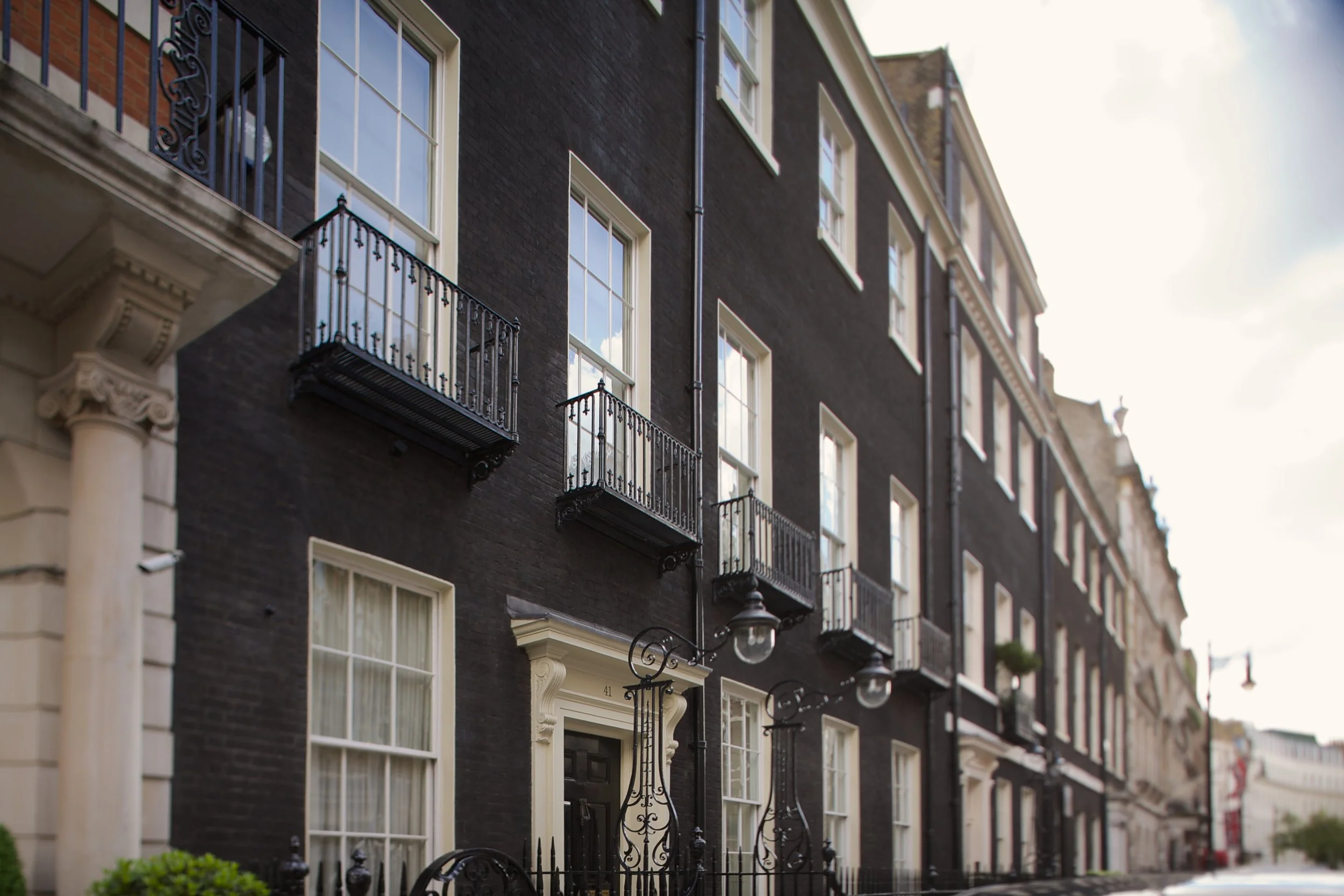
A listed property in Mayfair, refurbished by LA London
Listed Building Consent
LBC is formal permission granted by a local authority and required for any alterations to be made to a listed building. These include both internal and external changes, extensions or demolition.
Liquidated Damages
Determined at contract stage, liquidated damages are pre-agreed compensation paid by a contractor to the client for late completion. They are often calculated on a daily or weekly rate and protect the client in the event of work that overruns, without the need for litigation.
M&E / MEP
M&E (Mechanical and Electrical) or MEP (Mechanical, Electrical, and Plumbing) contractors deal with engineered systems in a building, such as heating, ventilation, lighting, power, drainage, cooling, data, AV and fire controls.
Massing
Massing describes the overall volume, form and shape of a building. Appropriate and sensitive massing decisions can minimise neighbour objections and increase the chance of planning success but often at the expense of built volume
Named Contractor
A named contractor (or named subcontractor) is a specialist chosen by the client or their design team to supply elements such as glazing, joinery or AV. This has become more common as construction has become more complex, requiring more specialist techniques. The main contractor generally remains liable to the client for any breach caused by named (sub)contractors, unless otherwise stated in the contract.

NBS (National Building Specification)
NBS is a technology platform and set of contractual specifications used by architects, engineers and contractors. It defines workmanship, material quality and performance requirements for a construction project.
NMA (Non-Material Amendment)
An NMA is a minor change to an approved scheme, such as slightly reducing the size of a building or moving windows without affecting neighbouring properties. Subject to a small fee, an NMA may be applied for without breaching any conditions originally placed on the consent and can be determined by the planning officers without needing to back out to consultation.
Party Wall Award
A legally binding agreement, negotiated by two surveyors, that outlines work to be carried out on or near a shared boundary (party wall). The agreement sets out how and when the work will be carried out and who will pay for each part of it. It protects both the person doing work and their neighbour.
Passive vs. Active Systems
In building design, a passive system is one that uses a structure’s form, orientation, insulation and shading to heat and cool it. Active systems use technology such as air conditioning units. The most efficient approach is often one that combines both passive and active systems.
Permitted Development (PD)
Permitted development rights allow homeowners to carry out improvements or extensions without having to apply for planning permission. Any building work still needs to meet certain standards and criteria, and requires a Certificate of Lawfulness.
Planning Conditions
Planning conditions control how a development is carried out by stipulating details like materials, drainage, operating hours and tree protection. The Local Planning Authority can take action if planning conditions are not followed. Often, specific conditions will need further details submitting and consenting before the development, or the relevant parts of it, can commence.
Planning Strategy
A planning strategy is the approach developed and agreed during the early design stage to maximise the chances of securing planning permission. It might include pre-apps (see below), phased submissions, or exploring alternatives like a Certificate of Lawfulness.
Planning Uplift
Planning uplift is the increase in value of a site or property that is brought about by securing planning permission. Value can be created at the moment approval is granted, before construction, and strategic approvals can exceed construction costs in value.
Plans / Sections / Elevations
Plans, sections and elevations are all types of scalable 2D drawings that illustrate a building from different perspectives. Plans are overhead views; elevations are flat, vertical views of the north, south, east and west faces of a building; and sections are vertical ‘slices’ that show the internal structure of a building and the relationship between spaces. Without all three views, a building cannot be fully understood, costed or built.

Examples of section drawings, these produced by LA Surveys
Point Cloud
One from our colleagues at LA Surveys: a point cloud is the survey data our laser scanners capture of a property. They are literally a cloud of points, each with precise x,y and z coordinates and colour data. The point cloud survey gives us accurate and reliable data that we know we can trust when developing our proposals for a project.
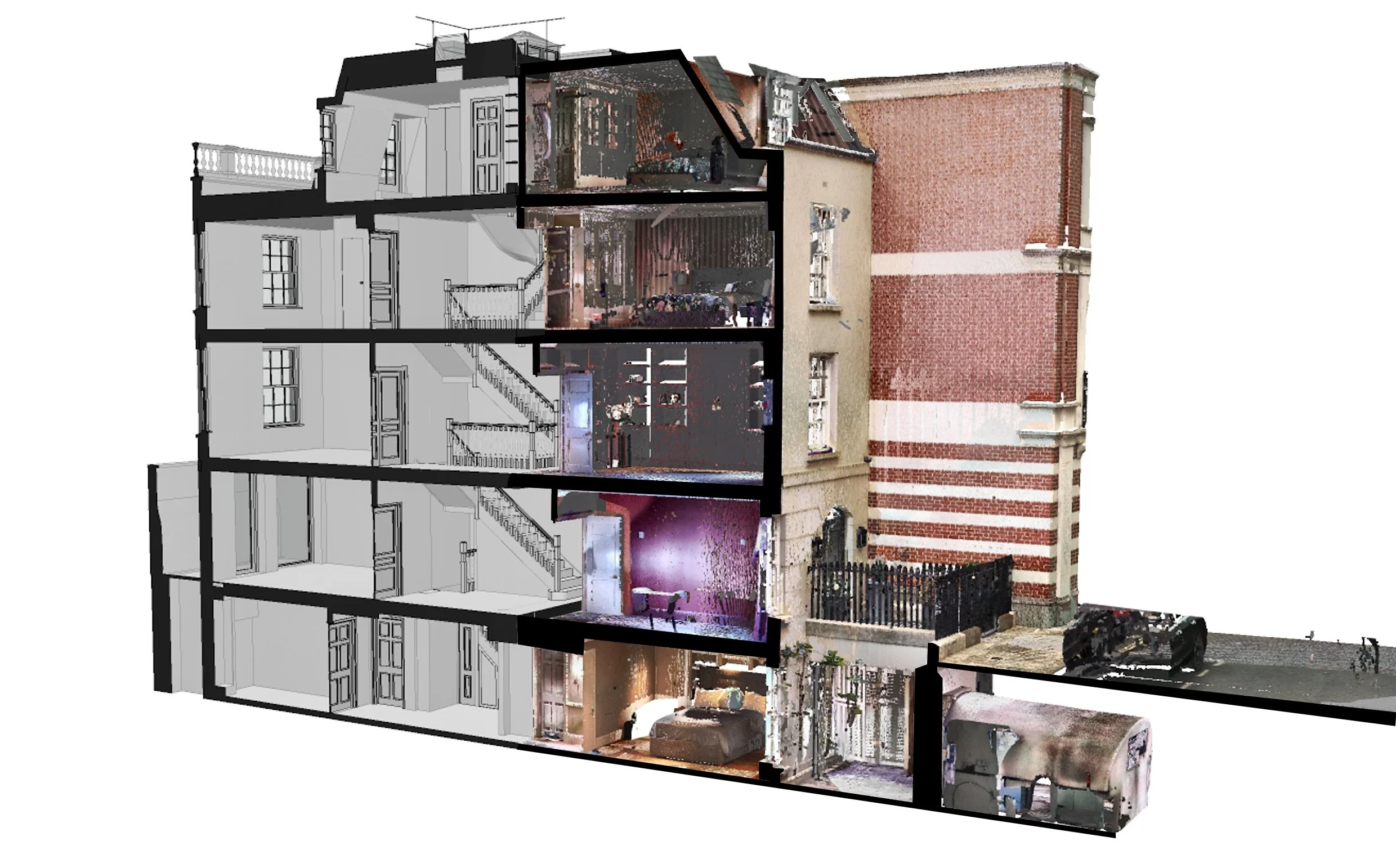
From point cloud (on the right) to BIM model (on the left)
Practical Completion
The point at which construction work is certified as complete under the building contract is known as practical completion. At this point, the client can occupy the site and half of the retention is released, even if there are some known defects still to be addressed. Final finishes, testing and rectification can continue after practical completion.
Pre-Application (Pre-App)
A pre-application is an informal early consultation with the planning authority that guides strategy and reduces the risk of planning refusal. It’s a way of obtaining advice on a proposed project before submitting a formal application.
Procurement Route
A project’s procurement route is the contractual approach taken to procuring the construction of a building. It determines where certain risks lie, how much design responsibility the contractor takes on how payments are made and how disputes are resolved. The chosen route should deliver the client’s objectives as efficiently as possible. Examples include Traditional and Design & Build.
Provisional Sum/ PC (Prime Cost) Item
A provisional sum is an estimate included in a construction contract for work that cannot be accurately valued at the point of tender. Too many PS/PC items in a contract means a lack of cost certainty at the point of signing the contract, which can lead to the project exceeding its budget.
Redline Markups
Annotations added to technical drawings to highlight changes needed or errors to be corrected.
Reuse/ Retention Strategy
An important part of the circular economy, the strategic retention and reuse of buildings and construction materials can reduce carbon emissions and cuts costs. It focuses on increasing the lifespan and value of existing structures and components to reduce environmental impact and waste.
Section 73 Application
Section 73 of the Town and Country Planning Act allows developers to apply for the variation or removal of a condition on an existing planning permission. The process is the same as applying for a new consent, and takes as long. It creates a new, separate permission that sits alongside the old one and can impact CIL liability.
Snagging/ Desnagging
Snagging occurs towards the end of a project and involves a detailed inspection of completed elements of work, first by the contractor and then by the designer. Any defective or incomplete work is flagged to the contractor to be rectified or “desnagged”.

LA London Associate Miruna Stroe carrying out snagging on site with our custom app.
Tender/ Tender Action
A tender is a formal bid or proposal submitted by a contractor or supplier to perform work on, or supply materials for, a project, based on a detailed design. While primarily focused on cost, it will also include a construction programme and details of relevant experience. Tenders are typically a competitive process but can be negotiated with a single contractor if that is considered preferable.
Traditional Contract
In contrast to a Design and Build contract (see above), a traditional contract is one where the client hires an architect and wider team to fully design their project, who then invite tenders from a select pool of suitable contractors. The contractor is therefore only responsible for building, not design, although it is rare for a traditional contract to not include some elements of CDP (Contractor’s Design Portion).
Look out for our next guide to the roles and responsibilities on a project team coming soon!