

LA London’s Guide to Architectural Acronyms
The construction industry in general, and architecture in particular, is rife with acronyms and abbreviations. While these may be a handy and familiar shorthand for those of us in practice, they often cause confusion for our clients, leaving them feeling uninformed about aspects of a project.
As we continue our explainer series to help clarify some of the industry’s technical language, titles and abbreviations, we’ve put together a guide to some common acronyms used in the world of architecture and design. The guide explains what they stand for, what they mean and how they are used.
Are there any you’d like to add? Let us know!
AI: Architect’s Instruction (or CAI: Contract Administrator’s Instruction)
A formal instruction issued by the architect or contract administrator directing changes, clarifications or additional work under the building contract.
AOD: Above Ordnance Datum
The AOD is a building’s elevation relative to sea level. It is an essential figure used in construction and surveying to understand the absolute height of a building or site, independent of the surrounding ground level.
ARB: Architects Registration Board
An independent regulatory body, established by Parliament in 1997. All architects must be registered with the ARB to legally call themselves an architect in the UK, where “Architect” is just one of three protected titles.
ASHP: Air Source Heat Pump
A low-carbon heating system that extracts heat from the outside air to provide heating and hot water for a building.
BIM: Building Information Modelling
A collaborative digital process using intelligent 3D models and shared data to design, coordinate, construct and manage buildings.

Every LA London project is designed and delivered using BIM
BNG: Biodiversity Net Gain
A planning and environmental requirement that development must leave biodiversity in a measurably better state than before.
BREEAM: Building Research Establishment Environmental Assessment Method
A sustainability rating system for the built environment, BREEAM is a rigorous assessment covering carbon, health, transport, water and management. It’s not mandatory for private homes, but is a valuable tool for ensuring large projects meet sustainability targets.
BSA: Building Safety Act
A 2022 law implemented in response to the Grenfell Tower disaster to improve building safety. It applies to Higher-Risk Buildings (HRBs) – buildings over 18m in height or those that have at least seven storeys and contain at least two residential units.
BSR: Building Safety Regulator
An executive non-departmental public body that regulates higher-risk buildings. Sponsored by the Ministry of Housing, Communities and Local Government, the BSR also works to raise safety standards for England’s buildings and improve built environment competence across England and Wales.
CA: Contract Administrator
A CA under a JCT contract administers the building contract on behalf of the client, issuing instructions, certifying payments and completion, and managing contractual procedures fairly and in accordance with the contract terms.

CDM Regs: Construction (Design and Management) Regulations
The principal UK health and safety legislation for construction projects, administered by the HSE (Health and Safety Executive) to protect those carrying out construction work and those affected by it.
CIL: Community Infrastructure Levy
A charge imposed on developments to fund local services. Most new developments that create additional floor space of 100 square metres or more, or a new dwelling, are potentially liable for the levy.
CPD: Continuous Professional Development
Architects are required to complete a minimum of 35 hours of CPD, or professional training, each year. This ensures they remain informed about regulations, technology, sustainability and safety. CPD compliance is regulated by the ARB.

LA Surveys offer a CPD presentation on the benfits of 3D surveys for renovation projects
D&B Contract: Design & Build Contract
A building contract where the contractor takes responsibility for both design and construction. This means the client has fewer contractual relationships, and can make the construction process quicker, cheaper and more efficient. The contractor has more freedom to select their own products and materials, so a comprehensive Employer’s Requirements document should be drawn up to protect design quality.
EA: Employer’s Agent
An EA under a JCT D&B contract acts on behalf of the client to administer the contract, coordinate contractual communications, and protect the client’s interests throughout the construction process.
EPC: Energy Performance Certificate
A certificate that tells you how energy-efficient a building is, based on an A–G rating, where A is very efficient and G is inefficient. EPCs tell homeowners how costly it will be to heat and light a property, and what its CO2 emissions are likely to be. EPCs are issued by qualified domestic energy assessors and are valid for 10 years from the date of issue.
FF&E: Furniture, Fixtures and Equipment
All loose items in a building, including lighting, shelving, appliances, furniture, soft furnishings and accessories, are considered FF&E.

FFL: Finished Floor Level
The FFL is the final height of a floor, including finishes such as tiles, carpets or timber. It is an important measure, usually marked on drawings, used to determine the height of elements like thresholds and walls.
GAs: General Arrangement Plans
These are large scale drawings of a building’s overall layout. They show spatial relationships, levels, circulation and openings and form the basis of planning, coordination and contract documents.
GIA: Gross Internal Area
The total internal floor area of a building. The standard for measuring property’s areas, it includes areas like corridors and stairwells, but excludes external wall thicknesses and balconies.
GSHP: Ground Source Heat Pump
A heating system that uses heat stored in the ground to provide energy-efficient heating and hot water.
HRB: Higher-Risk Building
A building over 18m in height or that has at least seven storeys, and contains at least two residential units.

Higher-risk apartment buildings at One Hyde Park, where LA London have extensive experience
HVAC: Heating, Ventilation, and Air Conditioning
HVAC systems regulate the internal temperature, humidity, and air quality of buildings. Modern systems prioritise energy-efficiency.
ID: Interior Design (or Interior Designer)
The discipline or professional role focused on the design, functionality, finishes and atmosphere of internal spaces.

An LA London project which we were Interior Designer for
IFC: Industry Foundation Classes
An open digital file format used to exchange BIM information between different software platforms.
JCT: Joint Contracts Tribunal
A widely recognised provider of standard UK building contracts. JCT contracts define risk allocation, payment terms, liability, workmanship, defects, and rights under construction law.
LADs: Liquidated and Ascertained Damages
Pre-agreed financial damages (not a penalty) payable by a contractor to the client if the works are completed later than the contractual completion date.
LBC: Listed Building Consent
Granted by a local authority, LBC is formal permission required before any alterations are made to a listed building. These include both internal and external changes, extensions or demolition.
LOD: Level of Detail
A defined level of graphical detail and information contained within a BIM model at a particular project stage, typically in the range of LOD 100 - LOD 500.
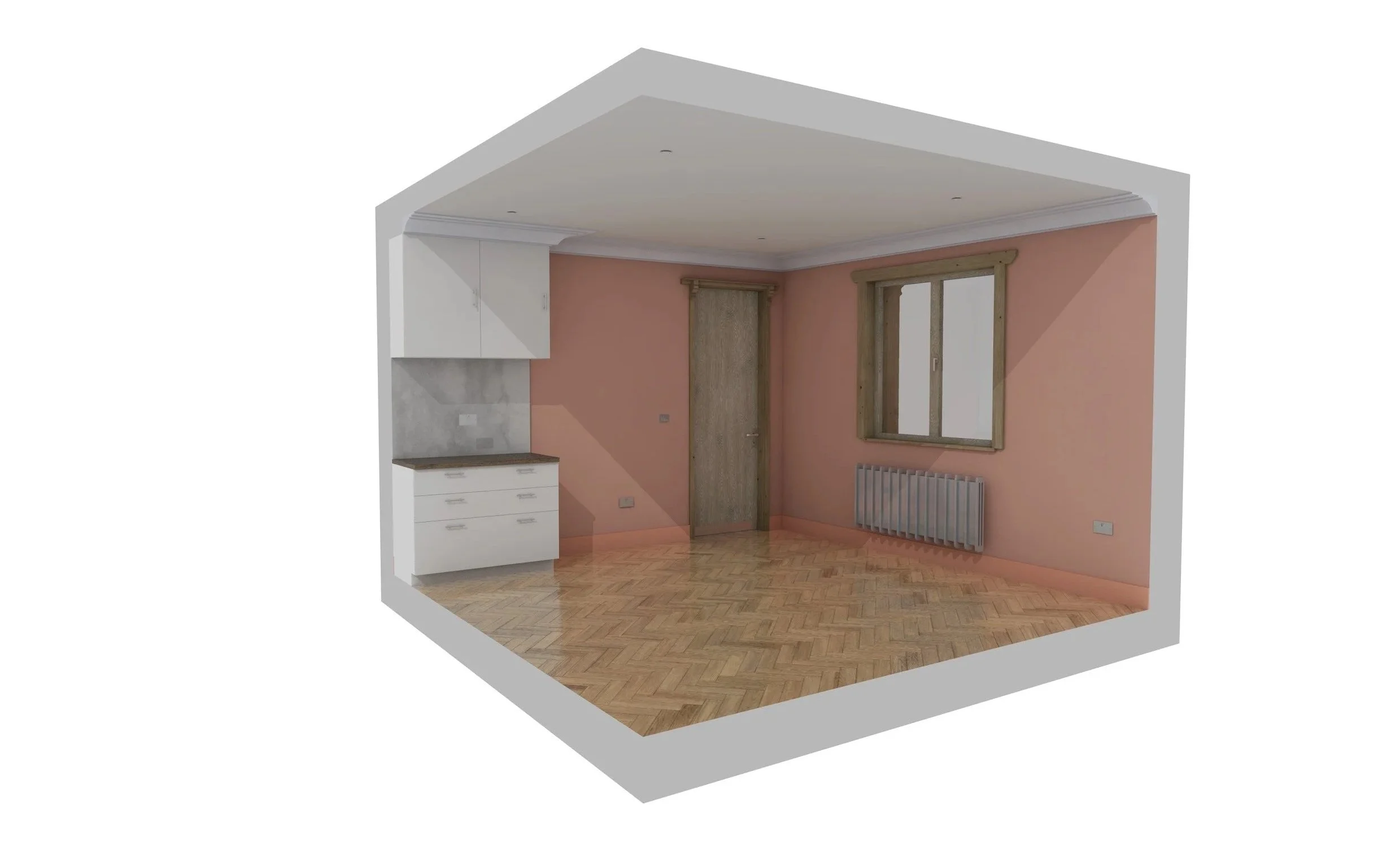
LA London typically build our BIM models to LOD 400
LPA: Local Planning Authority
Your local council handling planning applications. In prime Central London this includes, Westminster, RBKC and Camden.
M&E / MEP: Mechanical & Electrical (or Mechanical, Electrical & Plumbing)
M&E or MEP contractors deal with engineered systems in a building, such as heating, ventilation, lighting, power, drainage, cooling, data, AV and fire controls.
NBS: National Building Specification
A standardised, contractual system used by UK architects, contractors and engineers. It defines the materials, standards, and workmanship required for building projects. The NBS platform provides templates, information and digital tools to ensure quality and consistency from design to construction.
NEC: New Engineering Contract
A contract provided by the Institution of Civil Engineers to manage construction projects, mitigate risks, and prevent disputes. NEC contracts are the main alternative to JCT contracts, but less commonly used.
NMA: Non-Material Amendment
An NMA is a minor change to a planning-consented scheme, which may be granted without breaching any conditions originally placed on the consent. NMAs include slightly reducing the size of a building or moving windows without affecting neighbouring properties. They are subject to a small fee and can be determined by the planning officers without needing to go back out to consultation.

O&Ms: Operations and Maintenance Manual
A set of manuals and documents explaining how a building and its systems should be operated, maintained and serviced, handed to the client at Practical Completion
PC: Practical Completion
The stage at which construction works are substantially complete and the building can reasonably be occupied and used, as defined by the JCT contract.
PC: Principal Contractor
Appointed by the client, the principal contractor controls the construction phase and manages health and safety risks on a project that involves more than one contractor. Confusingly, the same title is used for a similar role regarding Building Regulations compliance.
PD: Principal Designer
The principal designer is appointed by the client to manage health and safety management during the design (pre-construction) phase. This can continue into construction if further design work is needed. A mandatory role required by law under the 2015 Construction (Design and Management) Regulations, it is most-commonly held by the architect. Confusingly, the same title is used for a similar role regarding Building Regulations compliance.

PD: Permitted Development
PD rights grant homeowners permission to carry out common improvements, conversions or extensions without having to apply for planning permission. Any building work still needs to meet certain standards and criteria, and requires a Certificate of Lawfulness.
PM: Project Manager
The project manager manages the delivery of a project on behalf of the client, ensuring work remains on schedule and within budget. Project managers’ responsibilities include reporting, risk management, budget tracking, schedule management and liaising between designers and contractors. They can also administer contracts (as CA) and advise on procurement.
PS: Provisional Sum
An allowance within a construction contract for work or items that cannot yet be fully defined at the time of tender.
QA: Quality Assurance
The systems and procedures used to ensure work is carried out consistently to the required quality standards. LA London have invested heavily in building a comprehensive system of robust processes.
QS: Quantity Surveyor
Quantity surveyors manage project costs, from initial calculations to final sums, ensuring projects are completed within budget and on time
RAMS: Risk Assessments and Method Statements
Contractor-prepared documents outlining the risks associated with works and the safe methods proposed to carry them out.

RIBA: Royal Institute of British Architects
The main professional body for architects in the UK, which sets professional standards and a ‘Plan of Work’ structure, from briefing to post-occupancy, used across the industry.
SAP: Standard Assessment Procedure
A UK government-approved energy rating that assesses the energy and environmental performance of new homes. It’s used for building regulations compliance and EPCs but will soon be replaced by the HEM (Home Energy Model) under the new Future Homes Standard.
SE: Structural Engineer
Structural engineers design buildings to withstand loads, ensuring they are safe and durable. They calculate structural strength, specify materials, and create blueprints for new buildings, renovations, and extensions. They also inspect existing structures for safety.
SPD: Supplementary Planning Document
Provides detailed guidance on how to apply policies in an adopted Local Plan. SPDs help to clarify complex issues or specific site developments.
SuDs: Sustainable Drainage Systems
Water management solutions designed to mimic natural drainage, slowing runoff and improving water quality. They use permeable surfaces, ponds, and channels to reduce flood risks and enhance urban environments.

TPO: Tree Preservation Order
A legal protection placed on trees by a local authority to control pruning, damage or removal.
Topo: Topographical Survey
A measured survey showing the physical features, levels, boundaries and contours of a site.
VE: Value Engineering
Often misunderstood as simply an exercise in cutting costs on a project, value engineering is more specifically optimising a design to minimise costs while achieving the same design intent and specified performance criteria more efficiently, e.g. through smarter detailing, alternative materials, prefabrication or structural solutions.
WLC: Whole-Life Carbon
The total carbon emissions associated with a building across its entire lifespan, including construction, operation and eventual demolition.