The Building That Inspired Me: Ema Benzar

Ema Benzar, Architect at LA London.
In our regular journal series ‘The Building that Inspired Me’, we hear from LA London team members about a building that has shaped their career in architecture.
This month, architect Ema Benzar chooses the Salk Institute in California, a an independent, non-profit scientific research centre in California.
Can you tell us about the building you have chosen?
I have chosen the Salk Institute for Biological Studies in La Jolla, California, designed by Louis Kahn and completed in 1965. Created as a research facility for scientist Jonas Salk, it is widely regarded as one of the most important architectural works of the twentieth century.
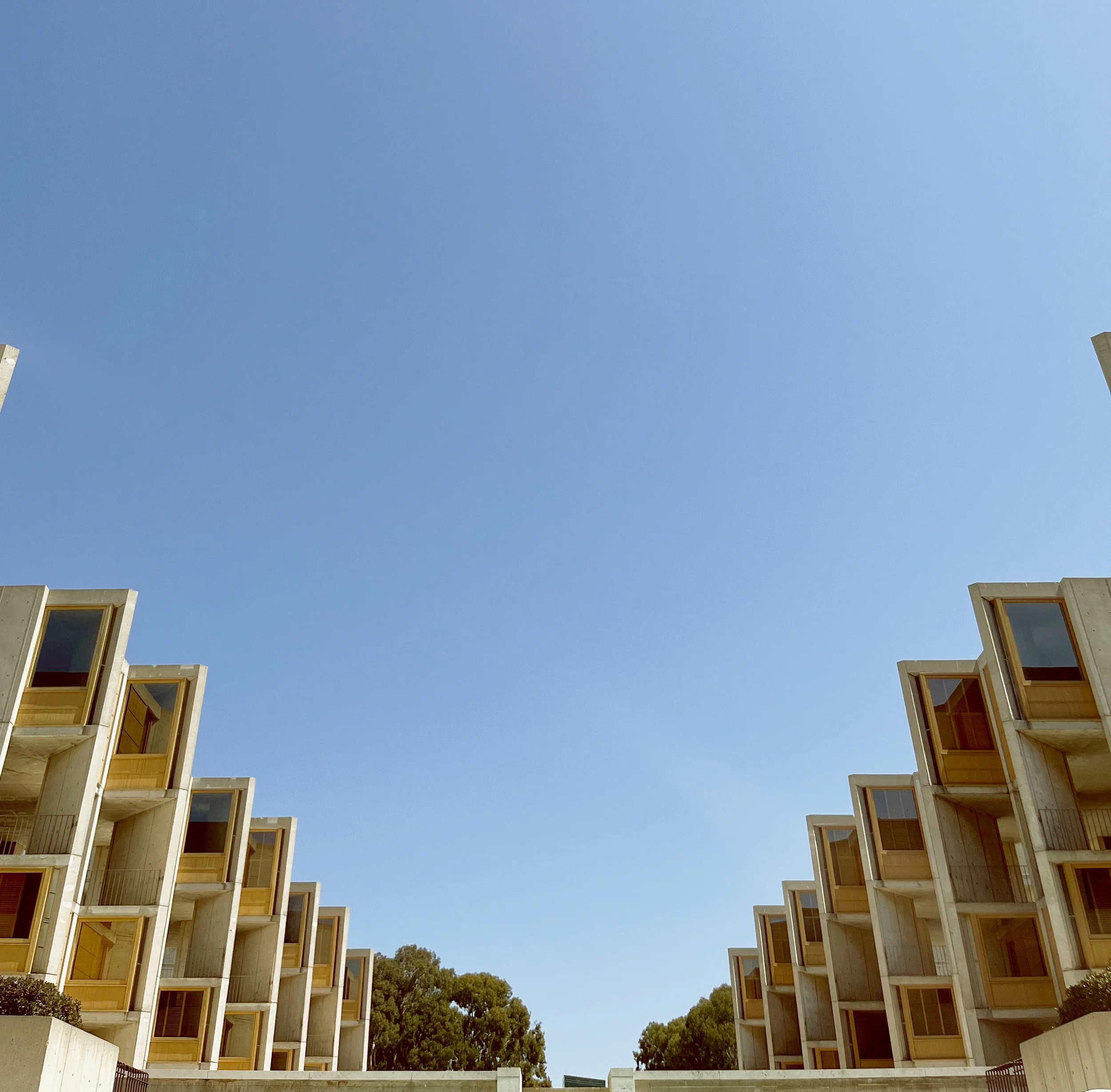
The institute is defined by two symmetrical laboratory buildings framing a central courtyard that opens towards the Pacific Ocean. Through its careful use of light, materiality, proportion and landscape, Kahn transformed a functional research facility into a place of both scientific discovery and contemplation.
More than 60 years after its completion, the Salk Institute remains a benchmark for how architecture can successfully unite programme, place and human experience.
Why is it inspiring?
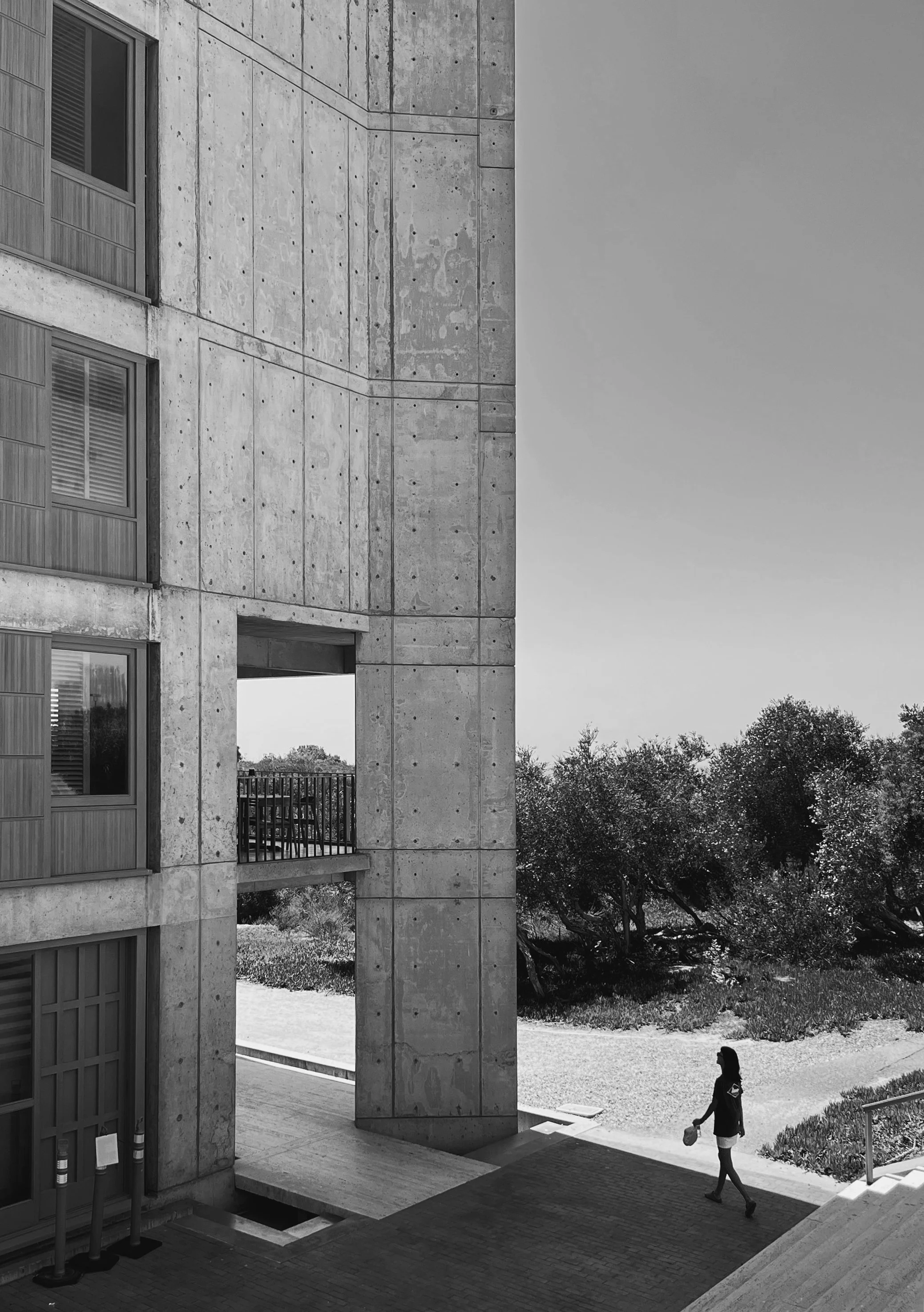
What I find most inspiring about the Salk Institute is the clarity of its architectural vision and the discipline with which that vision is realised. Jonas Salk envisioned an environment that would encourage scientific innovation, and Kahn responded by creating architecture that actively contributes to that ambition rather than simply accommodating it.
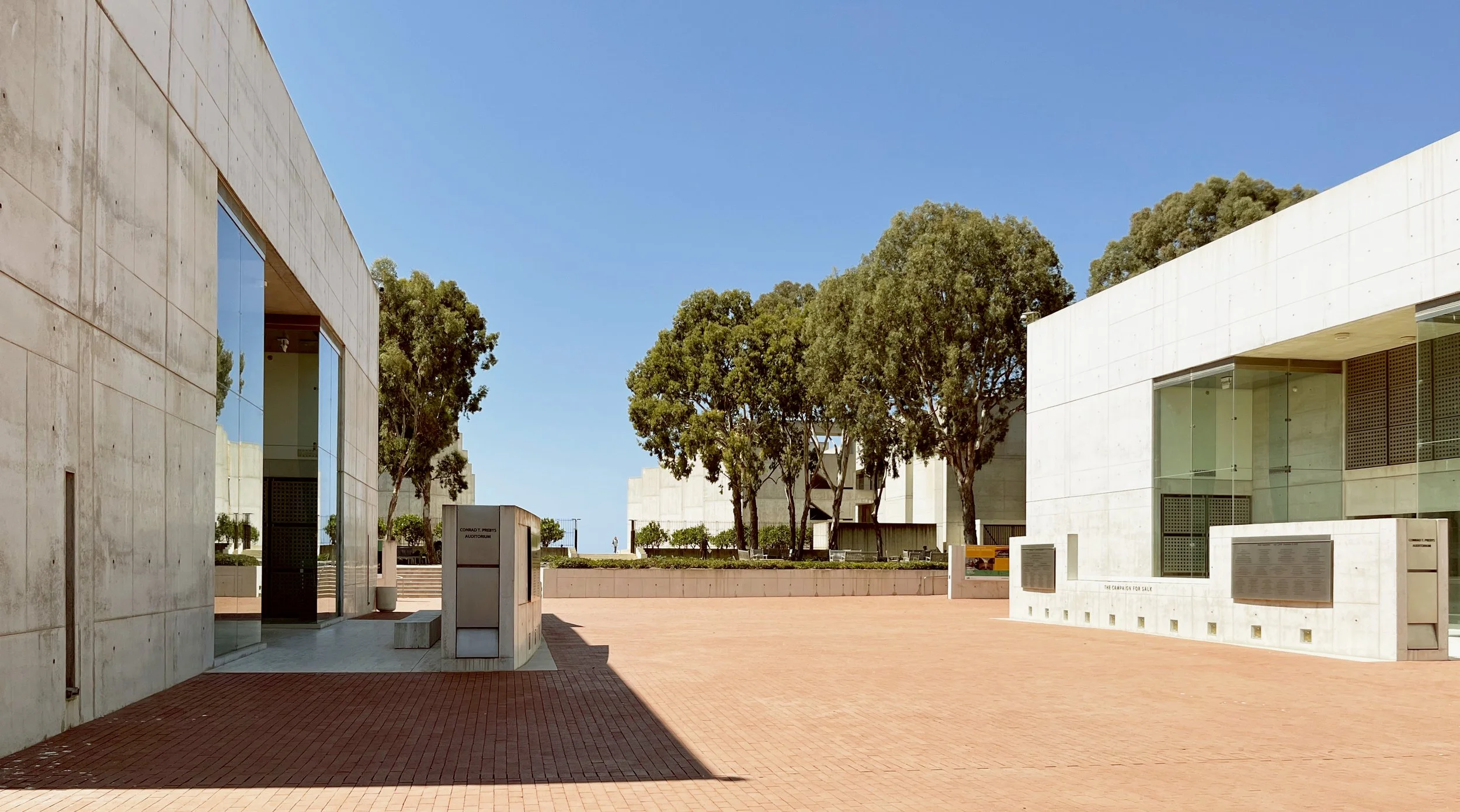
The institute shows a sophisticated understanding of spatial hierarchy and human experience. The two laboratory blocks frame a central courtyard that directs views towards the Pacific Ocean, establishing a powerful relationship between architecture, landscape and horizon. At the heart of the composition is the central water channel, the “River of Life”, which symbolically connects scientific discovery to the wider body of human knowledge represented by the ocean beyond.
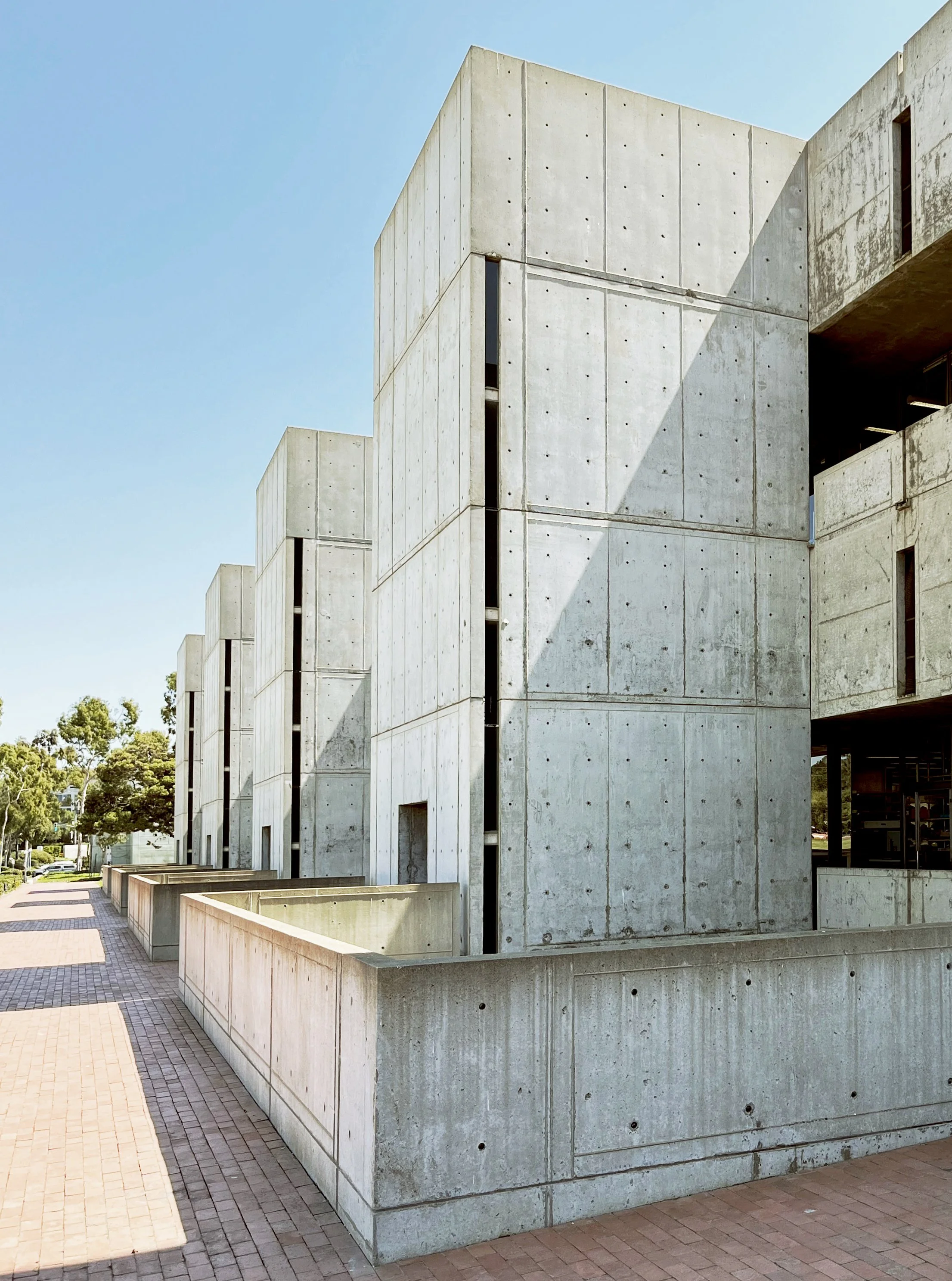
What particularly resonates with me is how the building engages all the senses. Drawing on ideas explored by Juhani Pallasmaa in The Eyes of the Skin, the institute offers not just a visual experience but a sensory one. The exposed concrete, teak and travertine create a tactile richness, while the changing light and deep shadows animate the space throughout the day.
Although I have visited the site twice, I have never had the opportunity to access the buildings themselves. Nevertheless, experiencing the campus firsthand reinforced my appreciation for qualities that photographs struggle to convey: the scale of the courtyard, the texture of the materials, the precision of the proportions and the way the architecture frames movement, light and views towards the horizon.
For me, the Salk Institute demonstrates that architecture does not need complexity to be profound. Its strength lies in the rigour of its concept and the consistency with which every element contributes to a coherent architectural narrative.
How did it influence your choice of career or your career path?
I first encountered the project during my first year at university when a studio tutor remarked that one of my designs appeared to have been influenced by Louis Kahn’s work. At the time, I was unfamiliar with the Salk Institute, but the comment prompted me to explore Kahn’s architecture in greater depth.
As I studied the project, I became increasingly fascinated by the apparent simplicity of the architecture and the level of thought underpinning every decision. What initially appeared to be a restrained composition revealed itself as a highly resolved project where structure, materiality, proportion, light and programme work together to support a singular architectural idea.
The Salk Institute also introduced me to a broader understanding of architecture as an experiential discipline. Through Kahn’s work, and later through texts such as The Eyes of the Skin, I became more aware of how architecture shapes memory, perception and emotion. The project demonstrated that buildings can influence how people feel and interact with a place through qualities that extend beyond aesthetics alone.
Since then, the Salk Institute has remained an important reference throughout my education and professional development. It encouraged me to look beyond formal appearance and focus instead on how architectural ideas are translated into meaningful experiences.
How has it affected your approach to projects at LA London?
It has encouraged me to focus on concept, spatial experience and user perception rather than individual architectural gestures. It serves as a reminder that successful projects are often driven by a clear idea that remains consistent throughout the design process.
At LA London, this has given me a greater appreciation for clarity, restraint and intentionality. Whether I’m working on early-stage concepts, planning submissions or technical packages, I try to consider how each design decision contributes to the overall narrative of a project and the experience of its users.
The project has also reinforced the importance of thinking beyond purely visual outcomes. Kahn’s work demonstrates how materiality, light, shadow, movement and proportion can shape the way people experience architecture on a sensory level. This aligns closely with Pallasmaa’s argument that meaningful architecture engages the whole body rather than the eye alone. As a result, I increasingly consider how spaces will be felt and inhabited, not simply how they will look.
Has your perception of this building changed during your time working in architecture?
Yes, although not in the sense that I admire it any less. I am just as impressed by the Salk Institute today as I was when I first discovered it; however, my appreciation of the project has evolved significantly through my architectural education and professional practice.
Initially, I was drawn to its formal qualities: the symmetry of the composition, the monumentality of the concrete structures and the powerful relationship between the courtyard and the Pacific Ocean. These made an immediate impression and helped establish the building as one of my architectural references.
Over time, however, I have developed a deeper appreciation for the conceptual and experiential dimensions of the project. What appears effortless is in fact the result of an exceptionally disciplined design process where every element supports the project's underlying purpose.
The more experience I gain within the world of architecture, the more relevant the Salk Institute becomes. It continues to inspire me because it demonstrates how architecture can achieve lasting significance when every design decision is rooted in a clear, purposeful and deeply human vision.
For more in this series, read LA London Associate Miruna Stroe reflections on T-House by Simon Ungers and Thomas Kinslow, Managing Partner Andrew Paulson sharing his love for La Sagrada Familia in Barcelona, and Partner Kathryn Archer reminiscing about the heyday of the Tynemouth Plaza.
Main image by Adam Bignell on Unsplash, other images by Ema herself.