Who Does What on a Prime Residential Project?
An expert and experienced team is vital to the success of any prime residential project, but what specialists should that team be made up of?
We recently outlined the numerous roles architects can perform on a project, which highlighted the often confusing similarity between titles and overlaps between roles. The same confusion can arise with other roles on a project – for example, “main contractor” and “principal contractor” – and where responsibilities overlap.
In addition, clients may be unsure when they need to engage the services of a particular company or individual, and who has overall responsibility for keeping the project on track.
To help provide clarity for clients embarking on renovation or construction work, we’ve put together a glossary of the roles and responsibilities of 12 key team members involved on a typical prime residential project.
Project Manager
On a prime residential project, the project manager oversees the overall delivery of the project on the client’s behalf, with a focus on ensuring that work stays on schedule and within budget. They are also responsible for reporting and risk management.
It is also common for the project manager to also act as the contract administrator (see below), advise on procurement routes, and liaise between designers and contractors during delivery.
LA London often acts as project manager for some of our smaller projects where there is a greater overlap with our lead designer and architect roles.

Contract Administrator
The contract administrator is appointed by the client to administer the building contract during the construction phase. Their role is to act impartially, protecting and enforcing the contract rather than the interests of a particular party.
The contract administrator issues contract instructions, certifies payments, assesses the validity of extension of time requests, manages the contractual implications of delays and defects, and certifies both practical and final completion.
The contract administrator role was traditionally undertaken by the architect but is now just as often carried out by the quantity surveyor or project manager.
Surveyor
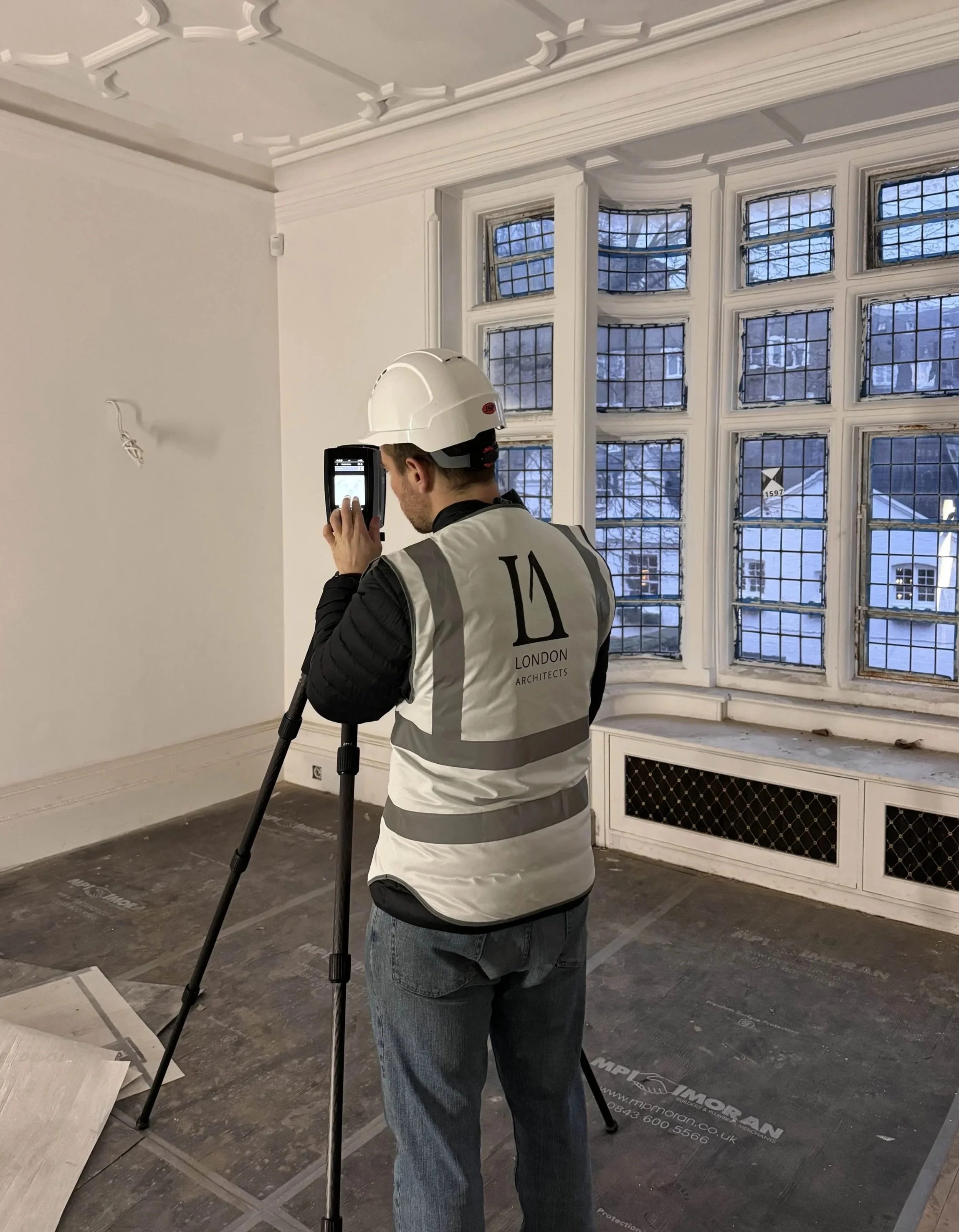
Measured surveys are a vital early step in any construction project, providing a detailed layout and accurate measurements to form the basis of future proposed drawings and plans. We’re fortunate to have our own surveying arm, LA Surveys, which delivers reliable measured surveys with our architects’ rigour and expertise.
In the event that a party wall agreement is necessary – when building work affects shared walls or neighbouring properties, for example – a specialist Party Wall Surveyor needs to be appointed to offer advice and ensure work and agreements relating to it are compliant with the Party Wall Act.
Structural Engineer
Architects work closely with structural engineers from the outset of any project to determine the feasibility and safety of our designs. Structural engineers can advise on suitable materials and environmental considerations, working out the loads and stresses a new structure needs to withstand. They also assess the site to determine any remediation that is needed to the existing structure and produce much of the technical documentation required for Building Control approval.
Once a project is on site, the structural engineer works with the architect and contractor to address any unforeseen structural issues that arise, adapting plans accordingly.
The structural engineer’s role is often particularly crucial on a prime residential project, which may include ambitious elements such as a basement excavation or large expanses of glazing.
Quantity Surveyor
The primary role of a quantity surveyor is to protect the client’s investment by estimating and managing project costs and timeframes. During the design stage of a project they work closely with the client to understand their needs, and assess the likely quantities and costs of materials and labour. They also advise on procurement and prepare tender packages and contracts, after which they will assess tender returns to ensure parity and prepare a report for the client to assist in selecting the contractor.
Once on site, they will monitor actual costs and validate the contractor’s monthly valuation of works completed. It is therefore common for the quantity surveyor to take on the role of contract administrator, acting as a neutral party to make sure the building contract is adhered to during the construction phase.
Interior Designer
The interior designer works closely with the client and the project team to create internal spaces that are both visually appealing and that serve the user’s wellbeing, comfort, and convenience.

Interior Designer: Lucarna
The interior designer’s role spans many stages of a prime residential project, from initial space planning and layout to choosing furniture and curating artwork. It is advisable to engage an interior designer as early as possible so that they can work with the architect and structural engineer on layout, M&E coordination and material selection.
Landscape Architect
Landscape architects design the spaces outside a home, including gardens, courtyards, patios and terraces. They produce plans for planting and structural elements according to the client’s requirements for their spaces, while allowing for environmental considerations like grading and drainage.

Landscape architects should ideally be involved from the outset of a project so that they can work with the architect to advise on issues like site orientation and ensure designs complement and enhance the building’s architecture.
Mechanical Engineer
The mechanical engineer is responsible for the heating, ventilation, and air conditioning (HVAC) system in a home. They often also oversee plumbing and drainage systems, although this can be carried out by a separate Public Health Engineer. Mechanical engineers work closely with architects, structural engineers and electrical engineers to make sure mechanical systems satisfy the client’s requirements and are coordinated alongside the structure and wiring. They should therefore be engaged at an early stage of a project.
The mechanical engineer also helps to ensure a space is energy-efficient by integrating sustainable technologies such as solar panels, heat pumps and MVHRs where possible. They are responsible for making sure that the mechanical systems comply with all relevant fire and building regulations.
Electrical Engineer

Electrical engineers plan electrical systems, lighting, power distribution, and communications. They can also integrate sustainable energy solutions including solar panels, battery storage, smart-home automation systems, and EV chargers.
The electrical engineer will often design both interior and exterior lighting schemes and draft detailed wiring plans, determining outlet placements and switch locations.
Electrical engineers also ensure systems adhere to safety standards (such as IET Wiring Regulations in the UK).
Mechanical and Electrical Engineering are usually offered as a combined package by a specialist M&E design consultancy.
Main Contractor
The main contractor is the company or individual contracted to construct the building. They lead the construction team, employ and manage subcontractors, control site operations, and deliver the physical building works in line with the contract.
Under CDM Regulations (see below), the main contractor typically becomes the principal contractor when there is more than one trade involved on a project.
Principal Contractor
Whereas the title ‘main contractor’ is a commercial one, ‘principal contractor’ is a legal title under health and safety laws, specifically the CDM (Construction (Design and Management) Regulations and Building Regulations.
The main contractor is usually the principal contractor, but it could be a role taken on by a project manager.
Principal Contractor (CDM Regulations)
Under the CDM 2015 Regulations, the principal contractor plans, monitors and coordinates the construction phase for projects involving more than one contractor.
They are legally responsible for managing construction health and safety, preparing the Construction Phase H&S Plan (a health and safety document required on all construction projects), and coordinating subcontractors.
Principal Contractor (Building Regulations)
In the context of the Building Regulations and the Building Safety Act, the principal contractor is responsible for ensuring construction works comply with Building Regulations during the construction phase and for managing safety reporting and compliance for higher-risk buildings.
Employer’s Agent
Appointed under a design and build framework, the employer’s agent liaises between the client, the contractor and the consultant team, representing the client (or employer in contractual terms) to administer the D&B contract.
They manage instructions and approvals, certify payments, and make sure work is completed in compliance with the contractual Employer’s Requirements.
In addition to the roles listed above, a prime residential project may involve any number of other specialists who offer invaluable expertise and insights, including fire safety advisors, acousticians, arboriculturists, security specialists, swimming pool designers and many more. LA London has developed an extensive network of trusted consultants, specialists and contractors for a range of project types, and can assist clients in building and overseeing a world-class team.
Find out more about what makes a successful project team, or contact us to discuss your own project.